How Engineered Wood (Glu-Lam) Is Made
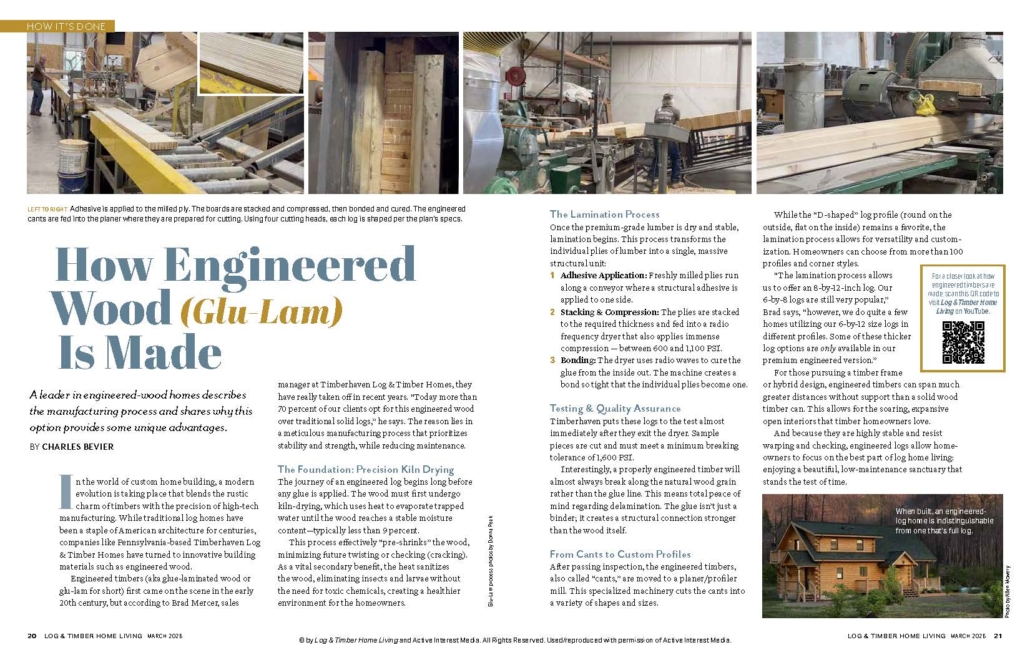
How Engineered Wood (Glu-Lam) Is Made: Reprinted with permission by Log & Timber Home Living | By Charles Bevier
Timberhaven, a leader in engineered-wood homes describes the manufacturing process and shares why this option provides some unique advantages.
In the world of custom home building, a modern evolution is taking place that blends the rustic charm of timbers with the precision of high-tech manufacturing. While traditional log homes have been a staple of American architecture for centuries, companies like Pennsylvania-based Timberhaven Log & Timber Homes have turned to innovative building materials such as engineered wood.
Engineered timbers (aka glue-laminated wood or glu-lam for short) first came on the scene in the early 20th century, but according to Brad Mercer, sales manager at Timberhaven Log & Timber Homes, they have really taken off in recent years. “Today more than 70 percent of our clients opt for this engineered wood over traditional solid logs,” he says. The reason lies in a meticulous manufacturing process that prioritizes stability and strength, while reducing maintenance.
The Foundation: Precision Kiln Drying
The journey of an engineered log begins long before any glue is applied. The wood must first undergo kiln-drying, which uses heat to evaporate trapped water until the wood reaches a stable moisture content-typically less than 9 percent.
This process effectively “pre-shrinks” the wood, minimizing future twisting or checking (cracking). As a vital secondary benefit, the heat sanitizes the wood, eliminating insects and larvae without the need for toxic chemicals, creating a healthier environment for the homeowners.
The Lamination Process
Once the premium-grade lumber is dry and stable, the lamination begins. This process transforms the individual plies of lumber into a single, massive structural unit:
1. Adhesive Application: Freshly milled plies run along a conveyor where a structural adhesive is applied to one side.
2. Stacking & Compression: The plies are stacked to the required thickness and fed into a radio frequency dryer that also applies immense compression — between 600 and 1,100 PSI.
3. Bonding: The dryer uses radio waves to cure the glue from the inside out. The machine creates a bond so tight that the individual plies become one.
Testing & Quality Assurance
Timberhaven puts these logs to the test almost immediately after they exit the dryer. Sample pieces are cut and must meet a minimum breaking tolerance of 1,600 PSI.
Interestingly, a properly engineered timber will almost always break along the natural wood grain rather than the glue line. This means total peace of mind regarding delamination. The glue isn’t just a binder; it creates a structural connection stronger than the wood itself.
From Cants to Custom Profiles
After passing inspection, the engineered timbers, also called “cants,” are moved to a planer/profiler mill. This specialized machinery cuts the cants into a variety of shapes and sizes.
While the “D-shaped” log profile (round on the outside, flat on the inside) remains a favorite, the lamination process allows for versatility and customization. Homeowners can choose from more than 100 profiles and corner styles.
“The lamination process allows us to offer an 8-by-12-inch log. Our 6-by-8 logs are still very popular,” Brad says, “however, we do quite a few homes utilizing our 6-by-12 size logs in different profiles. Some of these thicker log options are only available in our premium engineered version.”
For those pursuing a timber frame or hybrid design, engineered timbers can span much greater distances without support than a solid wood timber can. This allows for the soaring, expansive open interiors that timber homeowners love.
And because they are highly stable and resist warping and checking, engineered logs allow homeowners to focus on the best part of log home living: enjoying a beautiful, low-maintenance sanctuary that stands the test of time.