
A Class Act
Lynda, Thank you for all you do. You and your company are a class act. Every time I need something, you come through. I really appreciate all you do. Thanks again!
Brad Weiss
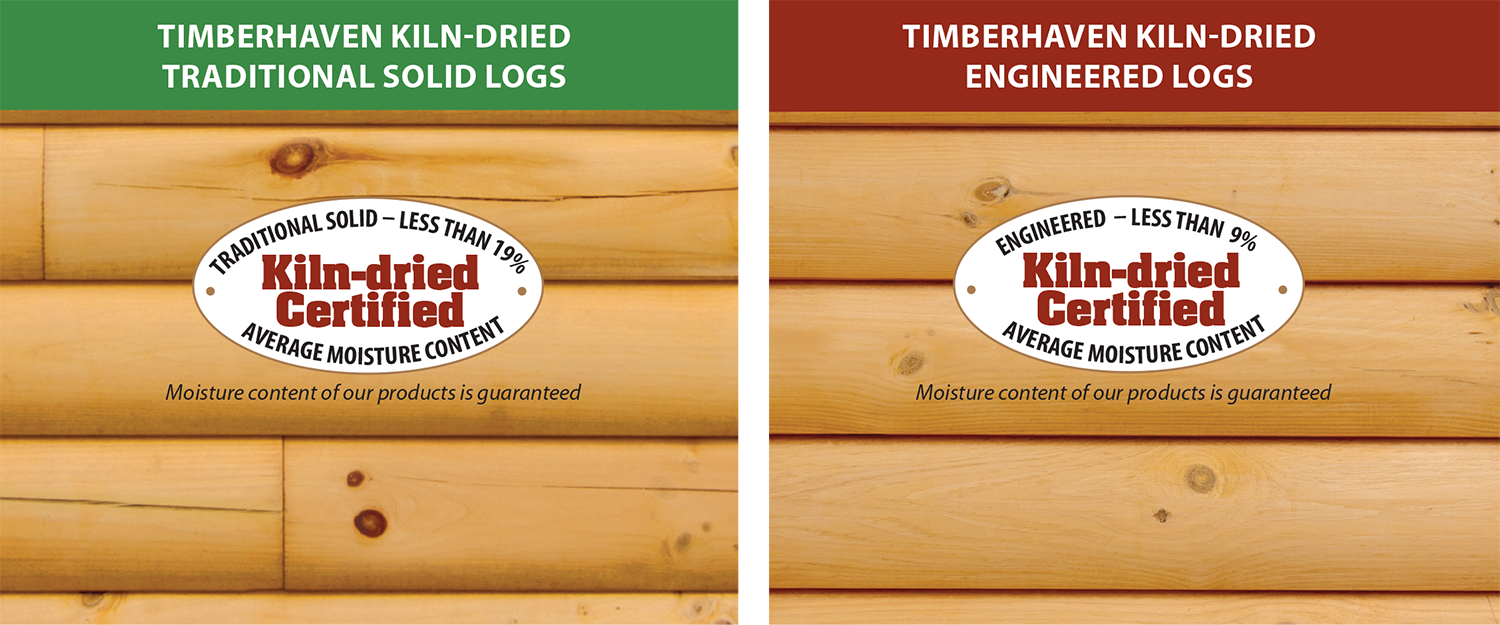
Timberhaven’s Eastern White Pine Kiln-Dried Traditional Solid Logs and Timbers are a single kiln-dried cant. These members are kiln dried to about 19% moisture content then milled into their final shape. The kiln-drying process reduces shrinkage, warping, and twisting while also killing insects and fungi. This is the log and timber choice for traditionalists who prefer the rustic appeal of a log or timber home—one filled with the distinctive character and charm so valued by log and timber frame home purists.
After decades of collective experience in the wood products business, we have found compelling evidence that kiln-dried log and timber products provide the most stable, troublefree building material. Over the years, we have collaborated with leading independent researchers – including Penn State University’s Dept. of Forestry, Montana University’s Wood Science Associates, and PFS Corporation – who agree and help us continually refine our technologies.
The process begins by placing a large stack of dimensional lumber (cants or 2x laminate plies) in a sealed building and slowly raising the temperature to 170 degrees Fahrenheit. Large fans maintain a consistent drying rate, and moist air is removed with dehumidifiers. The drying rate is carefully monitored, as the outside perimeters of lumber tend to dry faster than the centers. Uncorrected, this imbalance may cause severe checking (cracking). The final moisture content is measured in accordance to grading rules set forth by the Log and Timber Homes Council. After the 2x laminate plies (average 9 percent moisture content) or the solid cants (average 19 percent moisture content) are properly dried, they are ready for milling. The moisture content of our log and timber products is guaranteed in writing.
Kiln-Dried Log & Timber products— engineered or traditional solid —provide the best building materials possible, and this approach is backed by independent experts in the wood technology industry.
Air-drying large timbers usually takes longer than a year to achieve moisture content levels that are reasonably acceptable for construction. Proper kiln-drying provides much more predictable, controllable results.
~Dr. Paul Smith Professor of Forest Products Marketing Penn State University
The recommended moisture content of wood should be matched as closely as is practical to the equilibrium moisture content (EMC) conditions in service.
~USDA, Forest Service Forest Products Laboratory
Proper kiln-drying procedures control the drying environment and reduce the amount of severity of drying induced defects. Drying wood prior to installation provides an opportunity for the wood to maintain relatively stable dimensions during service.
~Paul Blankenhorn, Ph.D. Professor of Wood Technology Penn State University
There are two important differences between Air-Dried and Kiln-Dried. In a kiln, the wood is usually heated above 130F, which kills all insects, eggs, and fungi. Second, with resinous softwoods, the heat drives off the resin that would be liquid and runny at room temperature.
~Dr. Gene Wengert Dept. of Forestry University of Wisconsin
More and more log and timber frame home manufacturers claim to kiln-dry their logs and timbers, but unfortunately there are no industry standards. Some companies’ logs or timbers spend only a few days in the kiln; our controlled process requires more than 30 days. There are huge differences in the logs and timbers that kiln-dried manufacturers supply, so qualify the companies you are considering by asking these questions:
to view hundreds of member plans and save your favorite homes.
Don't have an account? Sign up
Enter your email address and we will send you a link to change your password.
to view hundreds of member plans and save your favorite homes